


Single Supplier vs Multiple Suppliers: Which Is Better for Furniture Retailers?
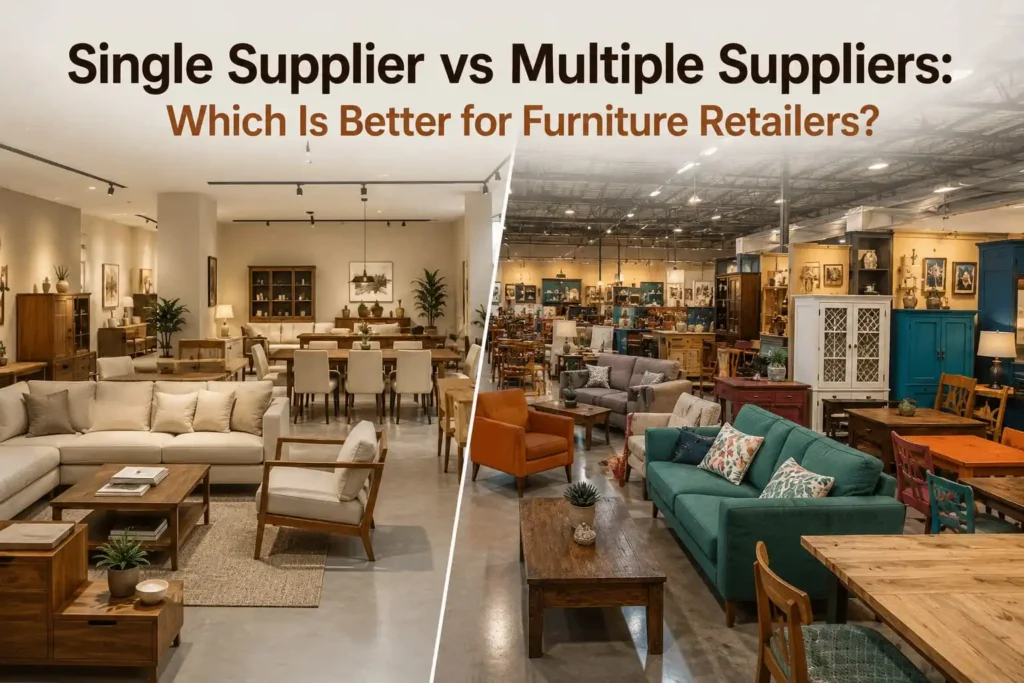
Choosing the right furniture sourcing strategy can have a major impact on a retailer’s margins, product quality, inventory planning, and ability to grow. One of the biggest decisions is whether to work with one furniture supplier for most of your collection or divide purchases between multiple manufacturers.
Both approaches have advantages.
A single supplier can make purchasing, communication, quality control, and logistics easier. Multiple suppliers can give retailers access to more designs, materials, price points, and specialist manufacturers.
For retailers sourcing wholesale furniture from India or other international manufacturing markets, the right choice depends on the size of the business, product range, order volume, and how much control the retailer wants over its supply chain.
Difference Between Single Supplier vs Multiple Suppliers
|
Factor |
Single Supplier |
Multiple Suppliers |
|
Communication |
Easier |
More complex |
|
Product variety |
Moderate to high |
Very high |
|
Quality control |
Easier to standardize |
Requires more monitoring |
|
Negotiation |
Stronger relationship |
More price comparison |
|
Logistics |
Simpler |
More coordination |
|
Supplier risk |
Higher dependency |
Lower dependency |
|
Easier to coordinate |
Depends on each supplier |
|
|
Container planning |
Simpler |
More complicated |
|
Product specialization |
May be limited |
Access to specialists |
|
Long-term relationship |
Easier to develop |
Spread across suppliers |
What Does a Single-Supplier Mean?
A single-supplier strategy means sourcing a large portion of your furniture collection from one manufacturer or export supplier.
For example, a retailer may source dining tables, dining chairs, coffee tables, sideboards, cabinets, wardrobes, and bedroom furniture from one Indian furniture manufacturer. The supplier becomes more than just a place to purchase products. Over time, it can become a long-term manufacturing partner.
This approach is particularly useful for retailers that want consistent materials, finishes, packaging, and quality across their product range.
Advantages of Using One Furniture Supplier
Simpler communication
Instead of discussing specifications, prices, production schedules, and shipping arrangements with several companies, you have one main point of contact. This can save considerable time when managing large furniture orders.
Consistent product quality
Working with one manufacturer makes it easier to establish a common quality standard. The same requirements can be applied across different furniture categories. For example, if your retail brand requires a particular wood moisture level, finish, packaging method, or hardware specification, the manufacturer can apply those standards across the collection.
Easier container planning
Furniture retailers often combine several products into a single container. A supplier producing multiple categories can make this process easier. You may be able to combine dining tables, chairs, coffee tables, cabinets, and sideboards without coordinating separate shipments from several factories.
Stronger supplier relationship
Long-term purchasing can create advantages that are difficult to achieve with one-off orders. As the relationship develops, manufacturers may become more familiar with your specifications, packaging requirements, preferred finishes, and quality expectations.
Better opportunities for customization
A manufacturer producing several categories for the same retailer can coordinate finishes and design elements across an entire collection. That is useful for retailers developing a recognizable furniture range rather than selling unrelated products.
Also Read: Custom Furniture Sourcing from India
Where a single-supplier approach falls short
Concentration risk
If your one supplier faces a production delay, quality issue, natural disaster, or simply decides to raise prices sharply, your entire catalog is exposed at once, with no backup in place.
Limited product range
No single manufacturer excels at everything. A supplier known for excellent solid wood joinery may not be the strongest choice for upholstered or metal-frame furniture, which can limit your catalog if you rely on them exclusively.
Less price competition
Without other suppliers to compare against, it's harder to know whether your pricing is genuinely competitive or simply what one relationship has settled into over time.
What Does a Multiple-Supplier Mean?
A multiple-supplier strategy means sourcing different furniture categories from different manufacturers based on their strengths. For example, one supplier may focus on solid wood dining furniture, while others specialize in bedroom, upholstered, metal, or outdoor furniture. This gives retailers greater product variety and access to specialized manufacturing expertise, but it also requires more coordination across suppliers.
Advantages of Working with Multiple Furniture Suppliers
Greater product variety
Multiple suppliers allow you to access different manufacturing styles, materials, designs, and price ranges. This can be particularly useful for retailers with large catalogues.
Access to specialists
Some manufacturers are highly specialized. One factory may be excellent at solid mango wood furniture, while another has stronger capabilities in upholstered sofas or outdoor teak furniture. Using both allows the retailer to choose the right manufacturer for each product category.
Reduced supplier dependency
If one supplier has a production problem, you still have other manufacturing partners. This creates a more diversified supply chain.
Also Read: How to Choose the Right Furniture Supplier
More competitive pricing
Having several suppliers also makes it easier to compare wholesale furniture prices.
Where a multi-supplier approach falls short
Higher administrative burden
Managing multiple payment terms, shipping schedules, quality standards, and communication threads takes real time and organizational capacity, particularly for smaller teams.
Inconsistent quality across your catalog
Different manufacturers, even when each individually reliable, rarely produce with identical finish standards or construction techniques — which can create a less cohesive product experience for customers comparing items within your catalog.
Diluted negotiating leverage
Splitting order volume across several suppliers means none of them sees your full purchasing power, which can mean less favorable pricing and priority than a consolidated relationship would achieve.
More vetting work upfront
Every additional supplier relationship requires its own due diligence — verifying export experience, requesting samples, and building trust from scratch — multiplying the work involved compared to deepening one relationship.
A Practical Framework for Deciding Which is Best
Rather than treating this as strictly either-or, most established furniture retailers land somewhere on a spectrum. A few questions help clarify where your business fits:
How broad is your product catalog
A narrow, focused catalog (say, solid wood dining and storage furniture) is often well served by one strong specialist supplier. A broad catalog spanning multiple materials and furniture types more often benefits from two or three suppliers, each covering their strongest category.
How much operational capacity do you have
If you're a small team without a dedicated sourcing or supply chain function, managing multiple supplier relationships well can stretch resources thin. A single strong relationship may serve you better until you have the bandwidth to manage more.
How risk-sensitive is your business model
Retailers with tight inventory timelines, seasonal demand spikes, or contractual delivery commitments to their own customers (hospitality projects, for example) often can't afford the concentration risk of a single supplier, regardless of how strong that relationship is.
How mature is the relationship with your current supplier
A newer supplier relationship, even a promising one, carries more inherent uncertainty than one tested across several successful orders. Newer retailers sometimes benefit from starting with two smaller relationships to compare reliability before consolidating around the stronger one.
Your Manufacturing Partner: Vandana International
For retailers leaning toward consolidating around a primary, reliable supplier, Vandana International works as a factory-direct manufacturer capable of supporting a retailer's core solid wood catalog — mango wood, sheesham, and acacia — with the consistency and customization access that a single strong relationship is meant to provide.
That includes:
- Consistent quality control on every orders, so retailers aren't managing shifting standards between production runs
- Customization and bulk orders support, which deepens as the relationship and order history grow
- Export experience across multiple international markets, reducing the documentation and compliance risk of working with a less experienced supplier
- Capacity to serve as a primary supplier for solid wood categories, while retailers pursue specialized secondary suppliers for materials outside that focus, such as upholstery or metal-frame furniture
Whether Vandana becomes a retailer's sole supplier or the primary partner in a hybrid structure, the goal is the same reliability and compounding relationship value this guide has focused on throughout.
Conclusion
Neither a single-supplier nor a multi-supplier approach is inherently better — each solves for a different priority, whether that's negotiating leverage and simplicity, or risk diversification and category range. The retailers who get this right tend to make the decision deliberately, based on their actual catalog, risk tolerance, and operational capacity, rather than defaulting into a structure by accident. For many, the answer isn't strictly one or the other, but a primary relationship supported by carefully chosen secondary suppliers where it genuinely adds value.
You Can Also Read More About: FOB vs CIF for Furniture Imports
FAQ’s
1. What are the risks of relying on a single furniture supplier?
Concentration risk — a delay, quality issue, or price hike from that one supplier affects your entire catalog at once, with no backup in place.
2. How many suppliers should a furniture retailer have?
Most established retailers use a hybrid model: one primary supplier for most of the catalog, plus one or two secondary suppliers for specialized categories or backup.
3. Does using multiple suppliers get better pricing than one supplier?
Not necessarily. Splitting volume reduces leverage with each supplier. Consolidated volume with one often earns better pricing over time.
4. When should a retailer add a second furniture supplier?
When your current supplier can't produce a category you need, reliability issues keep repeating, or your order volume makes risk diversification more important than maximum leverage.