


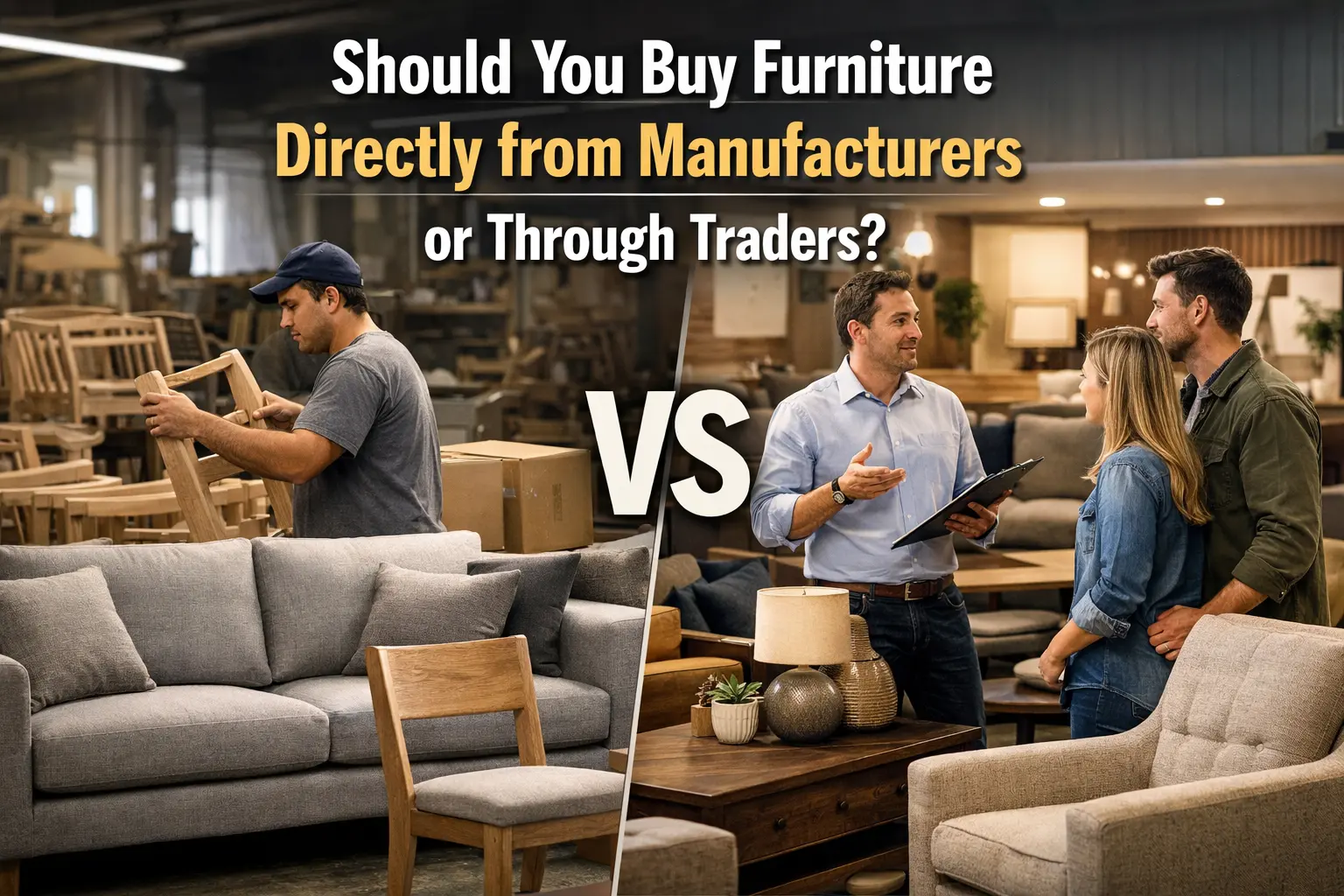
In international furniture sourcing, the decision is not just about products — it’s about choosing the right supply chain model. For importers, retailers, and project buyers sourcing from India, one key question often comes up: should you work directly with manufacturers or go through traders?
This decision directly impacts your pricing, product quality, customization flexibility, and long-term business growth. When dealing with furniture exporters in India, understanding this difference becomes even more important, especially for businesses importing furniture in bulk for global markets.
This guide breaks down the differences, advantages, and practical considerations to help you make the right decision for bulk furniture sourcing.
Understanding the Difference: Manufacturer vs Trader
Aspect | Furniture Manufacturer | Trader / Export Agent |
Role | Directly involved in production | Acts as an intermediary between buyer and factory |
Control Over Production | Full control from raw materials to finishing | Limited or no direct control over manufacturing |
Quality Consistency | High consistency across bulk orders | Can vary depending on different factories |
Pricing | More transparent and cost-effective | Higher due to added margins |
Customization | Easily supports design and specification changes | Depends on third-party manufacturers |
Communication | Direct communication with production team | Indirect communication through middle layer |
Production Timeline | More reliable and predictable | Can vary due to dependency on multiple suppliers |
Best For | Bulk buyers, long-term sourcing, B2B partnerships | Small orders, product variety, initial sourcing |
Why B2B Buyers Prefer Direct Manufacturers
For businesses importing furniture in bulk, working directly with furniture manufacturers in India offers several long-term advantages.
1. Better Pricing and Profit Margins
When you source directly from furniture manufacturers in India, you eliminate the additional layers that increase overall costs. Traders typically add their own margins, which can reduce your profitability over time. For buyers who deal in bulk orders, working directly with manufacturers helps create a more cost-efficient and transparent pricing structure.
This approach allows you to:
- Avoid extra costs added by intermediaries
- Get more transparent and structured pricing
- Negotiate better rates for bulk orders
- Improve overall profit margins
- Stay competitive in international markets
2. Consistent Product Quality Across Orders
Maintaining consistent quality is essential for businesses dealing in bulk furniture sourcing. Manufacturers who handle production in-house have better control over materials, processes, and finishing, ensuring uniform quality across large orders.
This approach allows you to:
- Maintain consistency across bulk production
- Ensure better control over raw materials and finishing
- Reduce the risk of quality variation
- Align products with your market standards
- Build trust with your customers
3. Flexibility in Customization
Customization plays a key role in B2B furniture sourcing, especially for businesses targeting different markets. Working directly with manufacturers makes it easier to adjust product specifications according to your requirements.
This approach allows you to:
- Modify product dimensions and specifications
- Adjust finishes, materials, and colors
- Develop new designs based on your needs
- Adapt products for different market demands
- Maintain consistency even with customized orders
4. Reliable Production and Delivery Timelines
Timely delivery is critical in international trade. Manufacturers manage their own production schedules, which helps ensure better planning and reduces delays in bulk orders.
This approach allows you to:
- Get more accurate production timelines
- Reduce dependency on third-party suppliers
- Improve inventory planning
- Ensure timely order execution
- Minimize delays in the supply chain
5. Strong Long-Term Sourcing Partnerships
Building direct relationships with manufacturers creates a strong foundation for long-term business growth. It improves coordination, trust, and overall efficiency in repeat orders.
This approach allows you to:
- Build stable and long-term business relationships
- Improve communication and coordination
- Ensure consistency in repeat orders
- Scale your sourcing operations smoothly
- Create a reliable supply chain for growth
When Traders Might Be Considered
While manufacturers are generally the preferred choice for bulk sourcing, traders can still be useful in certain situations. They are especially relevant for buyers who are exploring new markets or need flexibility in the early stages of sourcing.
1. Access to Multiple Product Categories
Traders often work with multiple factories, allowing them to offer a wider range of furniture styles and categories. This can be helpful for buyers who want to explore different product options without dealing with multiple suppliers.
This approach allows you to:
- Source a variety of furniture styles from one channel
- Access products from different manufacturers easily
- Explore multiple categories without separate sourcing efforts
- Compare different product options in one place
- Expand your product range quickly
2. Easier Entry for First-Time Buyers
For new importers, traders can simplify the sourcing process by managing supplier coordination and offering ready product options. This reduces the complexity involved in dealing directly with manufacturers.
This approach allows you to:
- Start sourcing without managing multiple factories
- Reduce the complexity of supplier communication
- Get quicker access to available product designs
- Save time in the initial sourcing stage
- Understand the import process more easily
3. Lower Initial Order Commitment
Traders sometimes offer more flexibility in terms of order quantities, which can be beneficial for buyers who are not ready to commit to large volumes.
This approach allows you to:
- Start with smaller order quantities
- Test product demand in your market
- Reduce initial investment risk
- Experiment with different product lines
- Scale gradually based on performance
4. Simplified Supplier Coordination
Managing multiple manufacturers can be time-consuming, especially for buyers handling diverse product requirements. Traders act as a single point of contact, simplifying coordination.
This approach allows you to:
- Deal with one contact instead of multiple suppliers
- Reduce communication gaps between parties
- Save time in managing supplier relationships
- Handle orders more efficiently in the early stages
- Focus more on business growth rather than operations
5. Faster Market Testing and Product Exploration
Traders make it easier to test new products and respond quickly to changing market trends without committing to large-scale production.
This approach allows you to:
- Experiment with different furniture designs
- Test new products in your target market
- Respond quickly to market trends
- Identify best-selling products faster
- Plan future bulk sourcing more effectively
What Works Best for Global Furniture Importers?
For businesses importing furniture from India to international markets, working directly with manufacturers is generally the more reliable and scalable approach. It gives buyers better control over quality, pricing, and overall supply chain performance, which is essential for long-term growth.
This approach offers:
- Better cost control
Direct sourcing helps eliminate intermediary margins, allowing you to manage pricing more effectively and improve overall profitability in bulk orders - Consistent product quality
Manufacturers maintain control over materials and production processes, ensuring uniform quality across large and repeat orders - Stronger customization capabilities
Working directly with manufacturers makes it easier to adapt designs, materials, and finishes based on your specific market requirements - More predictable supply chain
With direct coordination and structured production, timelines become more reliable, helping in better planning and inventory management
For long-term sourcing, this model supports business growth, operational efficiency, and a more stable supply chain.
Choosing the Right Export Partner Matters
In global trade, it’s not just about choosing between a manufacturer or a trader — it’s about working with an exporter who understands international standards and manages the process efficiently.
For B2B buyers, a structured and export-focused approach ensures:
- Smooth coordination from production to shipment
- Compliance with international requirements
- Consistent quality across bulk orders
- Reliable communication throughout the process
Working with an Export-Focused Manufacturer
For businesses sourcing furniture from India for international markets, partnering with an experienced exporter simplifies the entire process. At Vandana International, the focus is on serving global B2B buyers with a process-driven approach to furniture exports. The company specializes in manufacturing and exporting furniture exclusively for international markets, ensuring that every product meets export standards.
- Dedicated to bulk supply for overseas buyers
- Strong focus on quality and consistency
- Customization aligned with global requirements
- Export-grade packaging and logistics handling
- Structured communication throughout the order cycle
This approach helps importers, retailers, and project buyers build a more reliable and scalable sourcing system.
Final Thoughts
When importing furniture from India, the choice between manufacturers and traders can significantly impact your business outcomes. For B2B buyers targeting international markets, working directly with furniture manufacturers in India offers better control, consistency, and long-term value. While traders may offer convenience in certain cases, they often come with limitations that can affect scalability. The important thing is to focus on transparency, process, and experience. Choosing the right export partner ensures that your sourcing is not only efficient but also aligned with your business growth.
Read More About: How Can You Avoid Scams When Importing Furniture from India?
FAQs
1. Should I buy furniture directly from manufacturers or traders?
For bulk sourcing and long-term business growth, working directly with furniture manufacturers in India is usually the better option. It offers more control over quality, pricing, and customization compared to traders.
2. What is the main difference between a manufacturer and a trader?
A manufacturer produces furniture in-house, while a trader sources products from multiple factories. This difference impacts pricing, quality control, and communication in B2B sourcing.
3. Is it cheaper to buy furniture directly from manufacturers in India?
Yes, sourcing directly from furniture manufacturers in India is generally more cost-effective because it eliminates intermediary margins and allows better negotiation for bulk orders.
4. Do manufacturers offer customization for bulk furniture orders?
Yes, most furniture manufacturers for export provide customization options, including changes in design, materials, size, and finishes based on your market requirements.
5. Are traders reliable for long-term furniture sourcing?
While traders can be helpful initially, they may not always offer the same level of consistency and cost efficiency as direct manufacturers for long-term B2B sourcing.
6. How can I verify if a supplier is a genuine manufacturer?
You can verify by checking factory details, requesting production images or videos, understanding their manufacturing process, and confirming their export experience.
7. What are the risks of working through traders?
Common risks include higher costs, limited control over production, inconsistent quality, and slower communication due to multiple layers in the supply chain.
8. What is the best approach for long-term furniture sourcing from India?
For long-term growth, working directly with experienced furniture exporters in India who manage production in-house is the most reliable and scalable approach.