


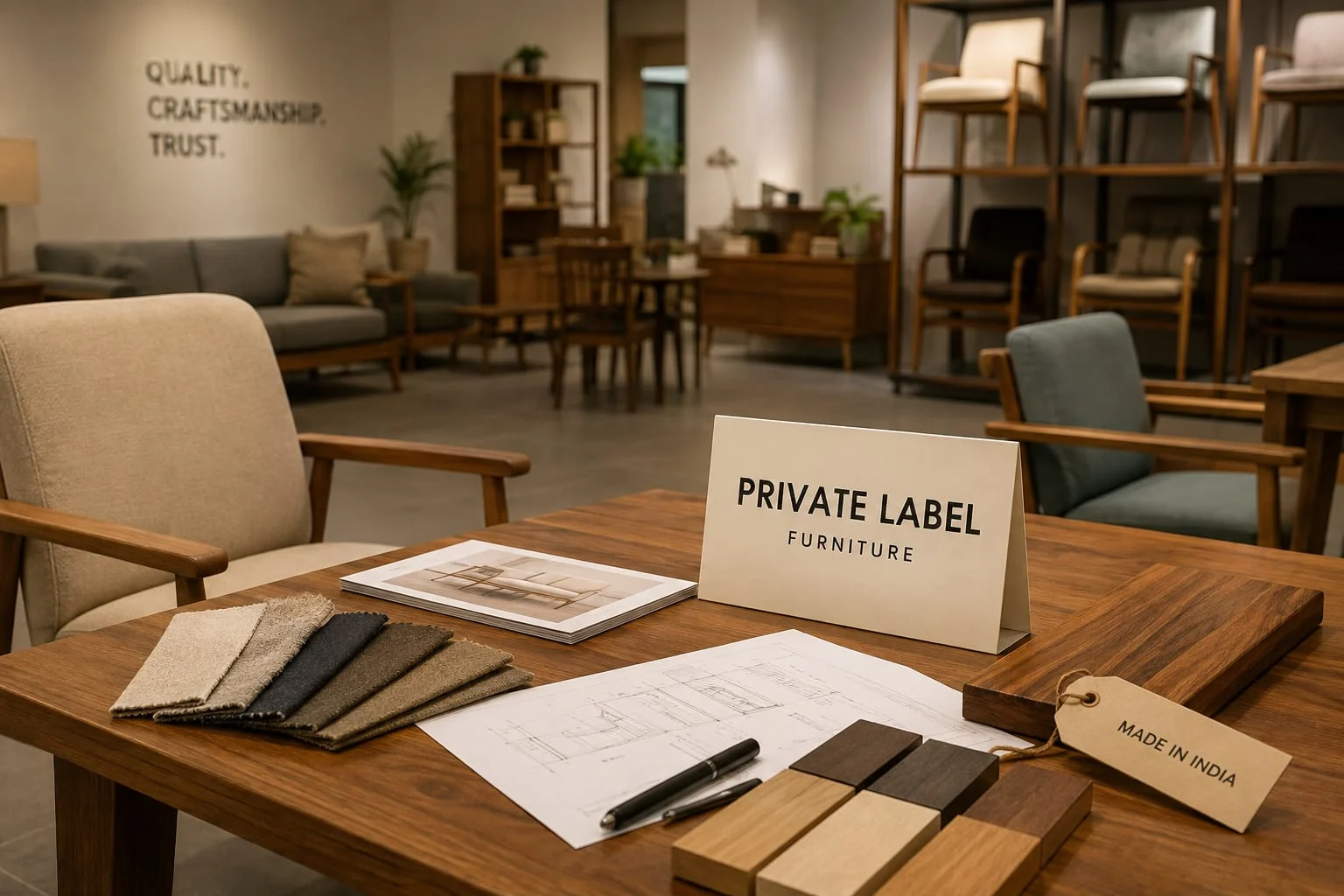
If you run a furniture retail business, a hospitality brand, or an online home decor store, you've probably hit the same wall every growing retailer hits eventually: reselling other people's branded catalogs only takes you so far. At some point, margins get thin, differentiation disappears, and you're competing on price against ten other stores selling the exact same sofa.
That's usually when retailers start looking into private label furniture manufacturing — sourcing furniture built to your own specifications, branded under your own name, and sold exclusively through your channels. And for a lot of retailers across the US, UK, Europe, and Australia, that search leads to one place: India.
This guide walks through exactly how the process works, what to expect at each stage, and the mistakes that trip up first-time buyers.
Private Label Furniture Explained: A Quick Definition for Retailers
Private label furniture is furniture manufactured by a third-party factory but sold under your brand name, with your labeling, packaging, and sometimes your exclusive designs. It's different from white label furniture, where a manufacturer sells the same generic product to multiple retailers who each slap their own label on it. Private labels usually involve more customization — your own SKU numbering, your own product names, your own packaging inserts, and often design tweaks that competitors buying from the same factory won't have access to.
For retailers, the appeal is straightforward. You control the brand story, you're not easily price-matched, and you build long-term customer loyalty around products nobody else stocks.
Why Retailers Choose India for Private Label Furniture Manufacturing
India has become one of the go-to countries for private label and OEM furniture manufacturing, and it's not just about cost. A few reasons come up again and again when retailers explain why they sourced from India specifically:
Deep craftsmanship in solid wood
Cities like Jodhpur, Jaipur, and Saharanpur have generations of woodworking expertise, particularly in mango wood, sheesham (Indian rosewood), and acacia. This matters if your brand positioning leans toward handcrafted, solid-wood, or rustic-industrial aesthetics rather than mass-produced engineered wood.
Lower MOQs than China for solid wood furniture
Many Indian manufacturers work with smaller retailers and newer brands, offering minimum order quantities that are more realistic for a business still testing a private label line, compared to some large-scale factories elsewhere.
Design flexibility
A large share of Indian furniture manufacturing is still workshop-based rather than fully automated, factories are often more willing to accommodate custom order, finishes, and small design changes without the tooling costs associated with more industrialized manufacturing hubs.
Cost efficiency without sacrificing material quality
Labor and raw material costs remain competitive, which gives retailers room to build in their own margin while still offering premium-feeling solid wood furniture.
Step-by Step process to Build a Private Label Furniture Line from India
Step 1: Define Your Product Line and Brand Positioning First
Don't contact manufacturers until you know what you're selling. Are you building a mid-range solid wood collection, a boutique acacia line for hospitality, or a budget cabinet range? Manufacturers can tell within a few messages whether you have a clear direction — and it affects how seriously they treat your inquiry.
Step 2: Choose the Right Manufacturer, Not the Cheapest One
Look at past prices, like check whether they're a factory or a trading company, whether their existing portfolio matches what you want to sell, their export track record to your target country, and how quickly and clearly they communicate. Slow replies now usually mean slow production later.
Step 3: Understand MOQs, Pricing, and Payment Terms
Most Indian exporters start MOQs around a single container (20ft/40ft), though some allow smaller trial orders. Pricing is usually quoted FOB, with 30-50% paid upfront and the balance against shipping documents. Avoid any supplier demanding full payment with no inspection checkpoint.
Step 4: Customize Branding, Labeling, and Packaging
This is what makes the line actually yours — custom labels, care cards, branded packaging, your own SKU/barcode system, and small design tweaks like finish or hardware. Confirm customization capability before placing a deposit, not after.
Step 5: Insist on Samples and a Pre-Shipment Inspection
Never skip physical samples — wood grain and finish quality are hard to judge over video. Once production starts, a pre-shipment inspection catches defects or quantity issues before the container leaves port, not after it lands.
Step 6: Get Certifications Right for Your Market
For US/EU imports, confirm ISPM-15 fumigation certification, FSC certification if sustainability matters to your brand, and CARB compliance if engineered wood or finishes are involved. Get these in writing before finalizing the order.
Step 7: Plan Realistic Logistics and Timelines
Ocean freight plus production typically means 3-5 months from first sample to shelf-ready stock, not the 6-8 weeks many first-time buyers assume. Decide upfront whether FCL or LCL fits your order volume.
Also Read: FCL vs LCL Shipping
Step 8: Treat the First Order as a Relationship, Not a Transaction
The most successful private label partnerships are built over 2-3 orders, not one. Reliable communication and patience through first-order hiccups usually earn better pricing and more flexible MOQs down the line.
Why Retailers Choose Vandana International for Private Label Furniture
If you're evaluating manufacturers for your private label line, Vandana International works directly with retailers, hospitality brands, and online furniture stores across the US, UK, Europe, and Australia to build custom, branded furniture collections — not just generic wholesale catalogs.
A few things that set the partnership apart:
- Factory-direct manufacturing, not a trading company — which means more control over customization, pricing, and production timelines.
- Specialization in solid wood furniture, including mango wood, sheesham, and acacia — well suited for retailers building a private label line around durability and natural material appeal.
- Flexible MOQs for private label partners, with options for smaller trial orders for retailers testing a new collection before committing to full-container volumes.
- Full customization support, including branded packaging, custom labeling, SKU/barcode matching, and finish or hardware adjustments.
- Export experience to key markets, with familiarity in the certifications and documentation (ISPM-15, FSC where applicable) that US and EU customs expect
If you're launching your first private label collection or expanding an existing one, Vandana International works with retailers from initial samples through to container-ready production.
You Can Also Read About: Buy Furniture Directly from Manufacturers or Through Traders?
Frequently Asked Questions
What is the minimum order quantity for private label furniture from India?
MOQs vary by manufacturer and product type, but many exporters work around single-container quantities for a first order, with some offering smaller trial runs for retailers planning long-term partnerships.
Is private label furniture manufacturing in India cheaper than domestic sourcing?
Generally yes, particularly for solid wood furniture like mango wood or sheesham pieces, though total landed cost needs to include shipping, duties, and import compliance costs, not just the factory price.
What certifications should I ask for when importing furniture from India?
At minimum, ask about ISPM-15 fumigation certification for wooden packaging, and FSC certification if sustainable sourcing matters to your brand. CARB compliance may also apply depending on materials used.
What's the difference between private label and white label furniture?
White label furniture is a generic product sold to multiple retailers who each apply their own branding. Private label furniture usually involves more customization — your own design tweaks, packaging, and sometimes exclusivity — rather than an identical product sold to competitors.