


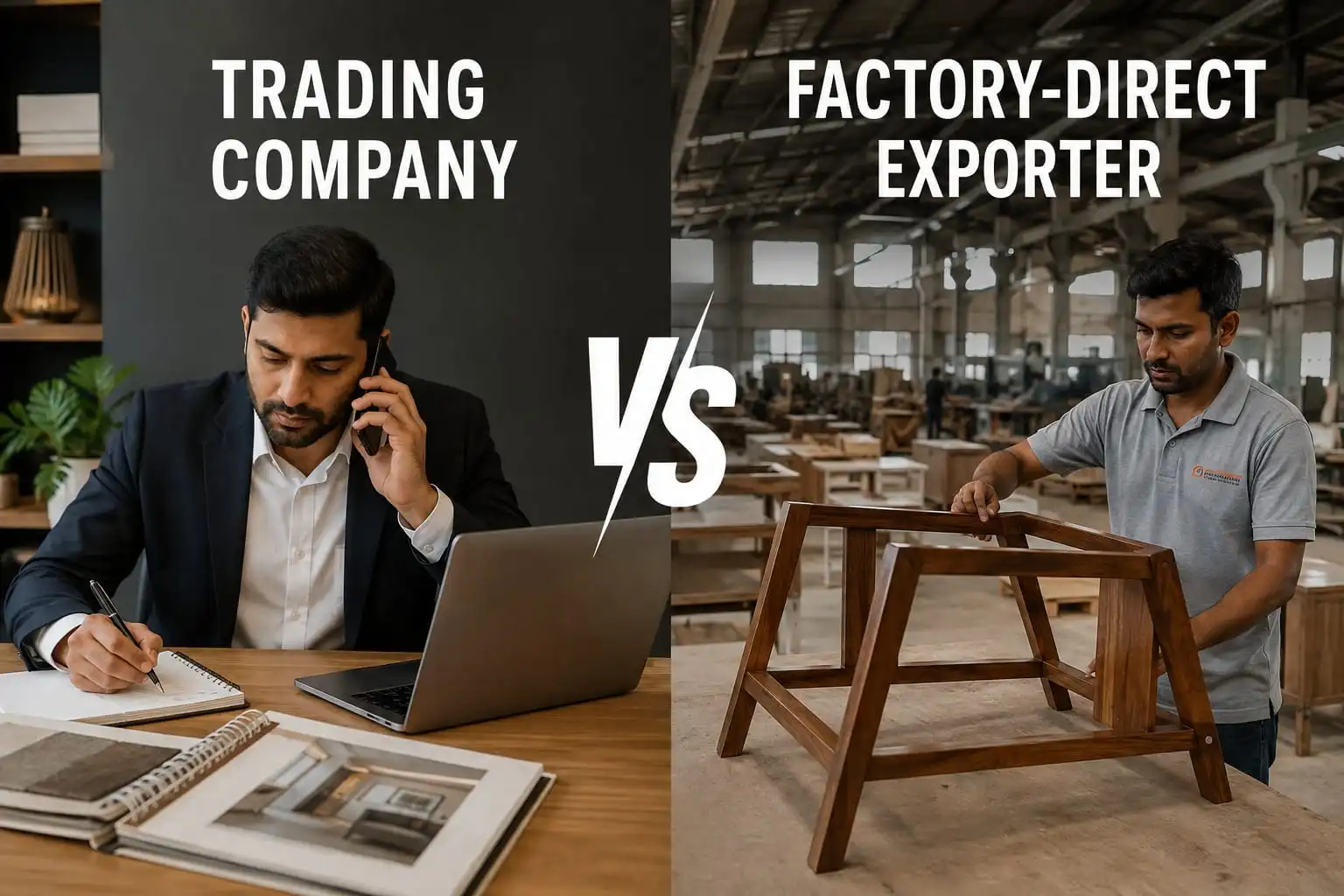
If you have spent any time sourcing furniture from India, you have already encountered both types of supplier — whether or not you knew which one you were dealing with. A trading company looks almost identical to a factory on the surface. The website shows workshop photographs. The catalogue is extensive. The sales team is responsive and speaks good English. The FOB price looks competitive. And then, three months into your first container order, something goes wrong — a finish inconsistency across 40 percent of the units, a production delay with no clear explanation, a quality issue that nobody can quite resolve because the person you are emailing does not actually control the factory floor.
This is the core practical difference between working with a trading company and working with a factory-direct exporter. And it matters far more than most buyers realise until they have experienced both.
What Is a Trading Company and What Does It Actually Do
A trading company acts as a middleman between the buyer and the manufacturer. Instead of producing furniture, it sources products from one or more factories and sells them to international buyers.
Trading companies usually manage quotations, samples, export documentation, communication, and shipment coordination. They often offer a wider product range because they work with multiple manufacturers. For buyers who want to source different furniture categories from a single supplier, a trading company can provide convenience and simplify the purchasing process.
What Is a Factory-Direct Exporter and What Makes It Different
A factory-direct exporter manufactures furniture in its own production facility and sells directly to retailers, importers, wholesalers, and commercial buyers, because buyers communicate directly with the manufacturer, they have better visibility into production, faster decision-making, and greater flexibility for customization. Questions about materials, finishes, dimensions, or quality are handled by the team actually making the furniture.
For businesses planning bulk orders or private label collections, working directly with a factory often provides better control over quality, pricing, and long-term supplier relationships.
Trading Company vs Factory-Direct Exporter: What's the Difference?
Although both can supply furniture for international markets, their role in the supply chain is very different.
|
Trading Company |
Factory-Direct Exporter |
|
Sources products from multiple manufacturers |
Produces furniture in its own factory |
|
Offers a wider supplier network |
Offers complete control over manufacturing |
|
Acts as an intermediary |
Buyers communicate directly with the production team |
|
Limited visibility into production |
Full production transparency |
|
Product customization depends on partner factories |
Greater flexibility for customized furniture |
|
Pricing includes intermediary margins |
Factory-direct pricing without additional trading margins |
Factory-Direct Exporter vs Trading Company: A Practical Comparison
Both sourcing models can work well, but they offer different advantages. The right choice depends on your business goals, order size, and the level of control you want over the manufacturing process.
Pricing and Overall Cost
Price is often the first factor buyers compare, but the lowest quotation doesn't always deliver the best long-term value.
Trading Company
A trading company purchases furniture from manufacturers and adds its own margin before selling it to buyers. While this may simplify sourcing, it can increase the overall purchase cost.
Factory-Direct Exporter
Working directly with a factory-direct furniture exporter removes the additional trading margin. This often results in more competitive pricing, especially for bulk orders and repeat purchases.
Best For:
- Trading Company: Small mixed-product orders from different factories.
- Factory-Direct Exporter: Bulk furniture sourcing and long-term purchasing.
Also Read: FCL vs LCL: Which Shipping Option Is Better
Product Quality and Quality Control
Consistent quality is essential for retailers and distributors building a reliable brand.
Trading Company
Quality depends on the factories the trading company works with. If products come from different manufacturers, maintaining consistency across orders can sometimes be challenging.
Factory-Direct Exporter
Since the manufacturer controls production, materials, finishing, and inspections, quality can be monitored throughout the manufacturing process, resulting in greater consistency.
Best For:
- Trading Company: Buyers sourcing standard products from multiple suppliers.
- Factory-Direct Exporter: Businesses where consistent quality is a priority.
Customization and Private Label Manufacturing
Many businesses today need more than standard catalogue products.
Trading Company
Customization options may be available, but approval often depends on the partner factory, which can slow the process.
Factory-Direct Exporter
A private label furniture manufacturer can usually offer greater flexibility for:
- Custom sizes
- Wood finishes
- Colours
- Hardware
- Branding
- Packaging
- Exclusive product designs
Direct communication also makes product development faster and more efficient.
Best For:
- Trading Company: Basic product modifications.
- Factory-Direct Exporter: OEM, private label, and fully custom order furniture.
Also Read: White Label Furniture
Communication and Transparency
Clear communication helps prevent costly mistakes.
Trading Company
Information passes through an intermediary, which may sometimes delay responses or create misunderstandings during production.
Factory-Direct Exporter
Buyers communicate directly with the manufacturing team, allowing quicker decisions, faster updates, and better production transparency.
Best For:
- Trading Company: Buyers who prefer a single point of contact.
- Factory-Direct Exporter: Buyers needing detailed production updates.
Production Capacity and Bulk Orders
For wholesalers and importers, production capacity is a key factor.
Trading Company
A trading company may source products from multiple factories, which can be useful for mixed orders but may result in varying production schedules.
Factory-Direct Exporter
Manufacturers manage their own production planning, making it easier to maintain consistency for bulk furniture orders, repeat purchases, and long-term supply programmes.
Best For:
- Trading Company: Mixed product sourcing.
- Factory-Direct Exporter: Large-volume production and repeat orders.
Long-Term Business Relationships
Successful furniture businesses rely on dependable suppliers, not just one-time purchases.
Trading Company
Trading companies are suitable for businesses looking for convenience or products from multiple manufacturers.
Factory-Direct Exporter
When you work directly with a furniture manufacturer in India, it helps build stronger partnerships over time. Manufacturers gain a better understanding of your product requirements, making future orders, new product development, and customization much smoother.
Best For:
- Trading Company: Short-term or multi-category sourcing.
- Factory-Direct Exporter: Long-term partnerships and business growth.
How to Identify a Genuine Factory-Direct Furniture Exporter
Whether you choose a trading company or a manufacturer, it's important to verify who you're actually working with. Many suppliers describe themselves as manufacturers, even when they outsource production. Taking a little time to verify your supplier can help avoid delays, quality issues, and unnecessary costs.
Here are a few practical ways to identify a genuine factory-direct furniture exporter:
- Ask for factory photographs or a virtual factory tour.
- Check whether the company owns its manufacturing facility.
- Request images or videos of the production process.
- Ask about the machinery, workforce, and production capacity.
- Verify their export experience and the countries they supply.
- Request product samples before placing a bulk order.
- Read customer reviews and ask for business references whenever possible.
A reliable manufacturer will usually be transparent about its production capabilities and happy to answer technical questions.
Which Option Is Right for Your Business?
The right choice depends on your sourcing requirements.
A Trading Company May Be Suitable If You:
- Need products from multiple factories.
- Want to place smaller mixed-product orders.
- Prefer working with one supplier for different product categories.
- Require assistance coordinating multiple manufacturers.
A Factory-Direct Exporter Is Often the Better Choice If You:
- Buy furniture in bulk.
- Need private label or OEM manufacturing.
- Require product customization.
- Want direct communication with the production team.
- Value consistent quality and long-term partnerships.
Many experienced importers eventually move towards factory-direct sourcing because it provides greater control over pricing, quality, and product development.
Why Global Buyers Choose Vandana International
At Vandana International, we work directly with furniture retailers, wholesalers, importers, hospitality businesses, interior designers, and commercial buyers looking for dependable manufacturing solutions.
As a factory-direct furniture exporter from India, we manage the complete production process—from selecting quality raw materials to manufacturing, finishing, quality inspection, export packaging, and international shipping support.
Businesses choose us because we offer:
- Factory-direct pricing with no unnecessary intermediaries
- High-quality solid wood furniture
- Private label and OEM manufacturing
- Flexible customization options
- Consistent production quality
- Export-ready packaging
- Reliable delivery schedules
- Dedicated support for international buyers
Our furniture collections include dining tables, chairs, TV units, sideboards, cabinets, shelves, mirrors, bedroom furniture, and many other categories designed for retailers and commercial projects worldwide.
We proudly supply businesses across the USA, United Kingdom, Netherlands, Germany, Spain, Belgium, Denmark, Australia, the Middle East, and other international markets. If you're expanding your retail collection or sourcing furniture for a large commercial project, our goal is to build long-term partnerships based on quality, reliability, and transparent communication.
Conclusion
Choosing between a trading company and a factory-direct exporter depends on your business needs. Trading companies can simplify sourcing from multiple suppliers, while factory-direct manufacturers often offer better pricing, greater customization, and more consistent quality for bulk orders.
Before making a decision, verify your supplier's capabilities, request samples, and choose a partner that can support your business for the long term. The right supplier delivers more than furniture—they provide reliability, consistency, and lasting value.
You Can Also Read More About: How to Choose the Right Furniture Supplier
FAQs
Q: How much more expensive is a trading company than a factory-direct supplier?
Typically 15 to 25 percent more per unit at equivalent quality. On a full container load order this adds up to a significant cost that compounds across multiple orders per year.
Q: Can a trading company guarantee the same quality as a direct factory?
Not consistently. Trading companies do not control the production floor, which means quality issues are harder to prevent, slower to identify, and more difficult to resolve than in a factory-direct relationship.
Q: When should I use a trading company instead of sourcing factory-direct?
When you need very small quantities below factory minimums, when you need multiple product categories from different manufacturing specialisms in one shipment, or when you are a first-time importer who needs additional logistics support.
Q: How do I verify that a supplier is a real factory and not a trading company?
Ask to see the production facility, ask who manages your production on the factory floor, ask for pre-shipment photographs of your specific order, and ask them to accommodate a small custom specification on a standard design. The answers will tell you what you need to know.